 Cartopia
The future of the automobile
The three key words for the cars of the future: Autonomous, Electric, and Connected.
Autonomous
While not fully autonomous, self-driving cars are already here, in some respects. A number of automakers have models with varying levels of 'driver support' features. Tesla is the most well-known name here, but Nissan, Subaru and Mercedes Benz also have self-driving features.
There are actually six levels of autonomous driving:
- Level 0
- Car only reacts to driver's input. It may have sensors that warn you of danger, but the car will not do anything on its own.
- Level 1
- The car can intervene somewhat, such as keeping you in the center of a lane.
- Level 2
- Various systems can now communicate with each other. Level 2 is the most advanced level of self-driving currently available in the US. Features include adaptive cruise control (keeps you a certain distance from other cars). Drivers can take their hands briefly off the wheel.
- Level 3
- The car can drive itself under specific conditions, although the driver must still remain aware and ready to take over at any time.
- Level 4
- The car can drive itself on known roads, and the driver does not need to take over at any time. Google's Waymo is an example of a Level 4 driverless car that is undergoing tests.
- Level 5
- Level 5 is still largely theoretical - at this level, the car would be able to drive itself, on any road and under any conditions. These cars would not even need a steering wheel or pedal.
The advantages of self-driving cars are numerous and obvious: Drunk-driving accidents would go to essentially zero. Self-driving cars don't get distracted, didn't have a fight with their spouse that morning, don't get sleepy, and don't get road rage.
Here's a full self-driving demonstration (Tesla). No audio.
Electric
The internal combustion engine has been around for over 200 years, but its days are numbered, at least in terms of automobiles. Electric vehicles accounted for just under 10% of new car sales in the world in 2021, essentially doubling from 2020 (4.6%), which was essentially double the 2019 mark (2.5%). While China has taken the lead in EVs in terms of total sales (3.3 million in annual sales in 2021 and 7.8 million EVs in use), Europe has the largest share of EVs in use as a percentage of total cars, at 19%, including 26% in Germany.
One of the advantages of electric cars is that they are environmentally friendly, as they do not emit pollutants. Note that this is open to debate - while it is true that EVs do not emit pollutants while in use, some studies suggests that the entire manufacturing process (so-called "well to wheel" analysis") suggests that the total reduction in emissions may not be as significant as expected, at least based on current technology.
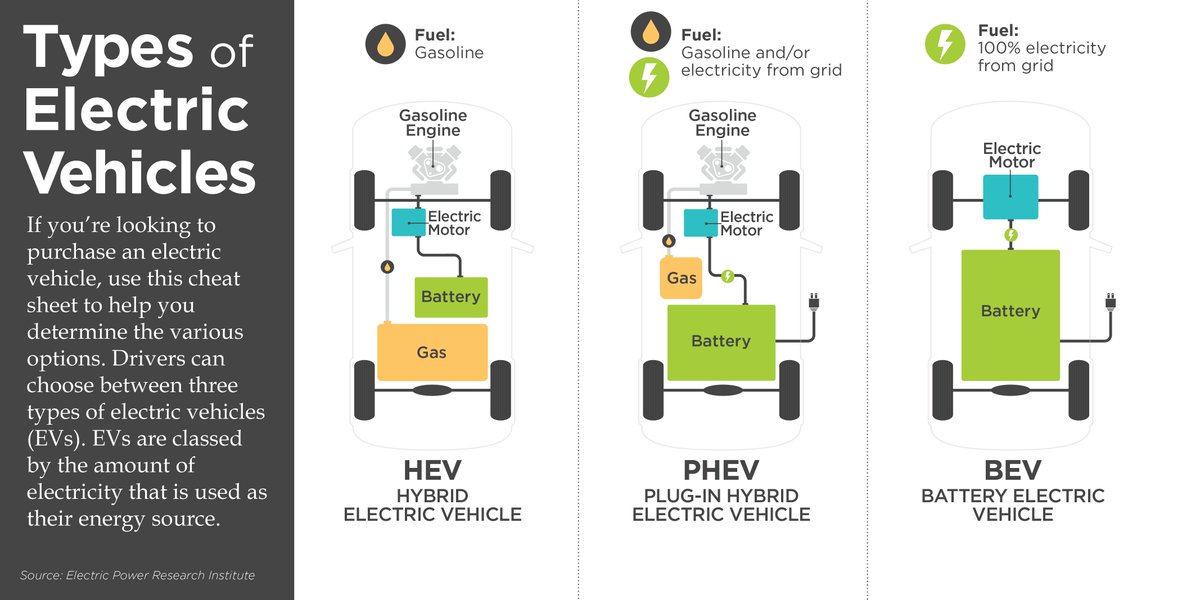
This infographic gives an overview of the key types of electric vehicles:
Connected
By 2030, cars will essentially be one big battery shuttling occupants around. Automakers will not be touting how 'fun' it is to drive their cars. Instead, they will be marketing the fun you can have while inside these big moving batteries. Connectivity will be the key here. Connectivity here refers to not just how your car will be connected to other devices around it for improved safety and navigation. Your car will be able to point out restaurants or convenient parking spots nearby. It will be able to drive itself to the charging station to charge up, or drive itself to the repair shop for maintenance. It will stream music, videos and games to the occupants.
This has tremendous implications for automakers: The automobile itself will simply be a commodity - the real technology (and money) will be in the battery. The key will be the various content that could be made available to the cars connectivity features.